Ladies Market > Stalls
Stalls
The market is 524 licensed pitches on Tung Choi Street, in four sections between Argyle Street and Dundas Street. Every pitch is licensed from noon to 11pm and built to the same standard size set by the licence, so the stalls look alike even when the stock does not. What changes from pitch to pitch is the stock, and most vendors sell one thing rather than a range.
How many stalls, and how far you walk
The four sections hold 130, 117, 135 and 142 pitches, so the density barely changes from one end of the street to the other. End to end they run the 455 m from Argyle Street to Dundas Street — six minutes at walking pace on our own street routing, and longer once you stop at a stall.
| Section | Pitches | Share of the market |
|---|---|---|
| Argyle Street to Nelson Street | 130 | 25 % |
| Nelson Street to Shantung Street | 117 | 22 % |
| Shantung Street to Soy Street | 135 | 26 % |
| Soy Street to Dundas Street | 142 | 27 % |
Licensed fixed hawker pitches on Tung Choi Street, by section (FEHD location plans MK-TCS-AN, -NS, -SS and -SD), all licensed 12:00nn to 23:00. 87 of the 524 were vacant at the register's last publication.
The practical consequence: with the sections this evenly matched, half an hour anywhere on the street shows you the same spread of stock — start at the end nearest you. If you are looking for a particular kind of stall, walk the whole street once without buying — the mix repeats, and the same category turns up again two sections down at a different price.
What a stall is
Every pitch is 2,400 mm by 900 mm — 2.16 m² of pavement — and built the same way: a steel tube frame with a plastic canvas cover, goods hung from the frame and stacked behind a counter. All four sections are the "morning set-up, evening dismantle" stall type that FEHD licenses on this street, so the frames and stock come down at the 11pm close and go back up before trading starts the next day. Nothing is left standing overnight, and the market is rebuilt before the noon start.
Every pitch is licensed for Class III goods, which in FEHD's classification is non-food dry goods: clothing, footwear, bags, cosmetics, household goods, jewellery, souvenirs. Food cannot be sold from a Tung Choi pitch. The class is the same in all four sections, so the licence does not make one stretch a clothing run and another a bag run: the same spread of categories repeats along the street, and the sections differ in size, not in kind.
The pitch is licensed, not rented. The licence is a fixed-pitch hawker licence issued by the Food and Environmental Hygiene Department to a named licensee who has to trade in person; a licence issued for a vacant pitch runs seven years and cannot be transferred or passed on. The annual fee is charged by pitch area: HK$4,347 up to 1.1 m², HK$5,512 up to 1.7 m² and HK$6,715 up to 2.2 m², which is the band a 2.16 m² pitch falls in.
What the stalls sell
The stock follows the season and the factories behind it, so the list below is the shape of the market rather than an inventory. Phone case stalls carry the current handset models; footwear stalls follow the season's sandals and trainers.
- Women's clothing — t-shirts, shorts, dresses, jeans
- Underwear, from plain cotton to lingerie
- Children's clothes
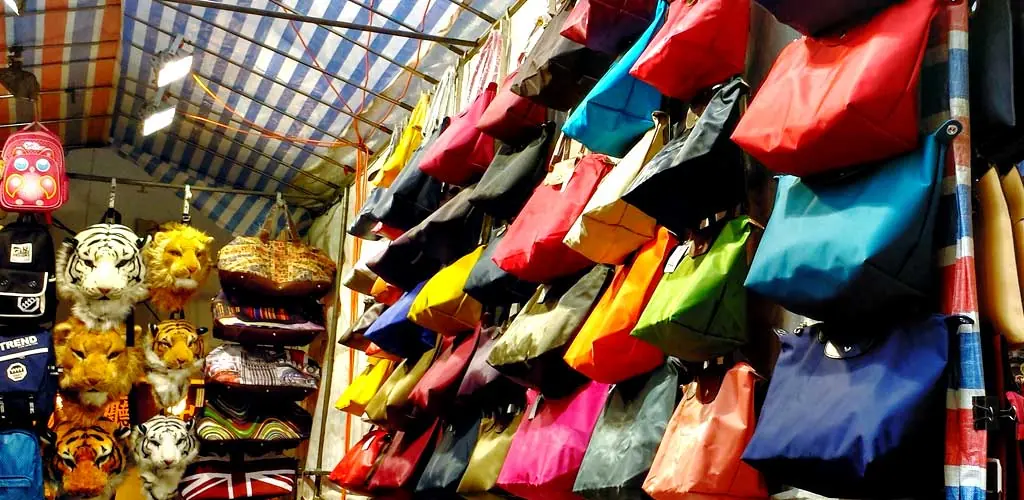
- Handbags, purses and wallets
- Shoes, flip-flops and sandals
- Hair accessories, hats and sunglasses
- Costume jewellery and fashion watches
- Mobile phone covers and accessories
- Cosmetics, fragrance and essential oils
- Towels and bedding
- Men's shirts, ties and belts
- Chinese-style table runners, cushions and decorations
- Souvenirs: magnets, keyrings, chopsticks, bags
What things cost
Prices are quoted per item. These are the bands the market trades in for the staples — near what haggling gets you, not the first number you will hear.
| Item | Typical price |
|---|---|
| HK-themed T-shirt | HK$60–100 |
| Dress | HK$100–200 |
| Handbag | HK$150–200 |
| Small souvenir | HK$20–80 |
| Fridge magnet | HK$10–30 |
Ranges drawn from visitor guides and checked 16 November 2026 — several are what people report paying after haggling, not the opening ask. Not a price list, and the stock turns over.
Buying from a stall
Offer about half the asking price and expect to settle somewhere around 60–70 % of it. Vendors quote high because they expect the counter-offer, and a stall selling one product can move fast on price at the end of a line of stock. Bring cash: the pitches are not set up for cards — see paying at the market.
Two things worth knowing before you start. The market is licensed, which means the pitch in front of you belongs to a named licensee trading legal hours, and it also means the copy goods sold openly on some pitches are exactly what Customs raid for — our guide to the fakes covers what is seized and why. And the stock turns over quickly: a style you see on Friday may be gone by the following weekend.