Ladies Market > Getting There > How to Pay
How to Pay at Ladies Market: Cash, Octopus Card or Credit Card
Ladies Market is a cash market. Almost everything you buy at a stall is settled in notes, on the spot, and the stalls that do take a card usually only do so for a bigger purchase. Step outside the stalls and the picture changes: an Octopus covers the MTR, buses, ferries and most chain shops, and since 1 April 2026 every Hong Kong taxi driver has to offer at least two kinds of e-payment on top of cash. This page sets out what works where, what the Octopus options actually cost, and how to have cash in your pocket before you start bargaining.
Quick answer: what works where
| Paying for | What to use | What to expect |
|---|---|---|
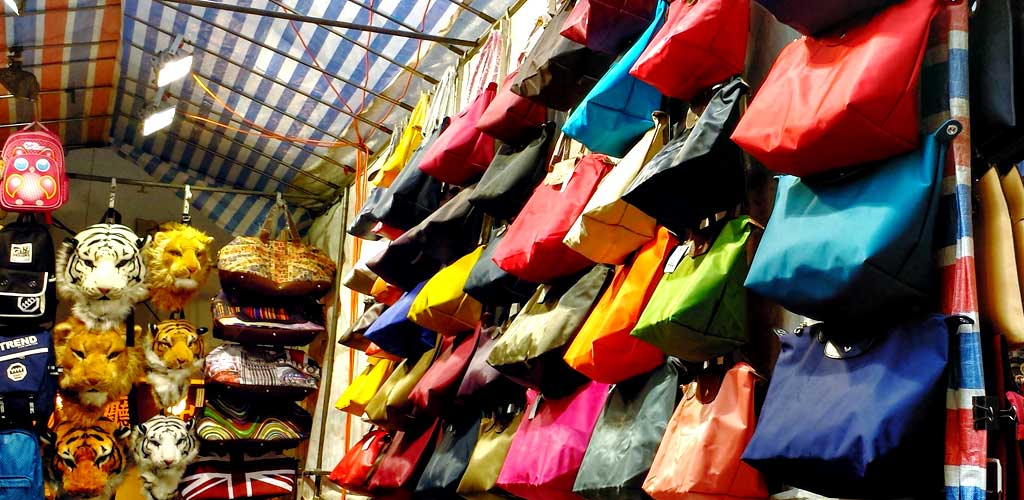
| Stall purchases — clothing, bags, souvenirs, toys | Cash in Hong Kong dollars | Most stalls deal in cash. Card acceptance is rare and generally tied to a larger purchase. |
| Chain shops, convenience stores, cafés, malls around Mong Kok | Octopus, bank card, QR wallet or cash | These normally work here. Fixed prices here, so no bargaining. |
| MTR, buses, ferries, trams | Octopus | Tap and go. A single-journey ticket is the alternative if you have not bought a card. |
| Taxi to or from the market | Cash, or one of the driver's e-payment means | Since 1 April 2026 drivers must provide at least two e-payment means — one QR code and one non-QR code. Cash is still accepted. |
| A price you have just bargained down | Cash | Agree the price and pay in cash on the spot; see our bargaining guide for the numbers. |
Paying the stalls
Treat cash as the default at the stalls, not the fallback. A vendor who has just spent five minutes haggling with you over a bag is not going to be impressed by a card, and many pitches have no reader at all. The few stalls that do take a card tend to reserve it for a larger purchase, and where there is no reader, the price you agree sitting across the counter is the price you are expected to produce in cash a moment later.
That has a practical consequence: you make a lot of small payments in an afternoon. A market like this is built on cheap individual items, so the awkwardness is not the total you spend, it is the number of times you have to hand over a note and wait for change. Carry a working pocket of small notes and keep the rest of your cash out of sight. Vendors may refuse a large note outright, or answer that they have no change — sometimes as a bargaining move, sometimes because a big note really has cleaned out the float.
How much to carry is a judgement, not a rule. Work out what you expect to buy, add a margin for the thing you did not plan to buy, and top up the next day rather than carrying everything at once. Cash you do not spend is still yours; cash you left in the hotel safe is not available at the one stall that will not take anything else.
Is an Octopus card worth it for a market trip?
Yes, if you are moving around Hong Kong — and no, if you read "Octopus" as a way to pay the stalls. An Octopus is the city's stored-value card: it pays the MTR, buses, ferries and trams, and it is accepted in chain shops, convenience stores and cafés. It is not a stall payment method. What you are really choosing between is three products with different money tied up in them.
Octopus options for a visitor
| Card | What you pay up front | What that buys you |
|---|---|---|
| Tourist Octopus (Sold version) | HK$39 | The card only — no deposit, no stored value. You top it up yourself, and you keep the card as a souvenir. |
| Tourist Octopus – China T-Union Card (Sold version) | HK$42 | Same terms, and it also pays for public transport in the Chinese Mainland and Macao. |
| On-Loan Octopus (Standard Octopus, adult) | HK$50 deposit plus HK$150 initial stored value — HK$200 in total | A card that works immediately. The HK$50 deposit is refundable when you hand the card back. |
The difference that matters is what happens at the end of the trip. On a Sold card — either version — you can get any remaining value back, but the card is deactivated and the cost of the card itself is not refunded, which is exactly what you are paying for if you want a souvenir. On an On-Loan Octopus the deposit comes back too, which is why it is the cheaper option for anyone who will actually return the card. Child and elder versions of the On-Loan card come with HK$50 of initial stored value instead of HK$150.
Two details catch people out. First, the refund is not always free: Octopus charges a handling fee of HK$11 or 1% of any remaining value, whichever is higher, on an On-Loan Octopus that has more than HK$1,000 left on it, and/or is returned within 90 days of issue, and/or has been used for five payment transactions or fewer. On a short trip with an ordinary balance, that is the rule to read before you queue at the counter. Second, you do not need to chase a refund at all if you would rather keep the balance for a next visit — but do not over-load the card: Octopus caps the total value on one card at HK$3,000, which is far more than a trip to a street market needs.
Buying one is easy in Mong Kok. Standard (On-Loan) Octopus cards are sold at MTR Customer Service Centres at all stations except a named list that includes Airport, Lo Wu, Lok Ma Chau and a handful of others — Mong Kok station is not on that list, so the Customer Service Centre there works. The Sold Tourist Octopus is bought outright from the stockists Octopus lists on the Sold Tourist Octopus product page; check that page before you set out, because the list is short.
If you would rather not carry a card at all, Octopus on iPhone or Apple Watch is added through the Octopus App for Tourists, and Octopus puts that at nearly 190,000 acceptance points; Huawei Wallet Octopus works at over 180,000, though only for Huawei accounts registered in the Chinese Mainland, Macao or Singapore. Both can be set up before you arrive, which is one queue you skip.
Cards and mobile wallets at the market
Around the market — the chain shops, the convenience stores, the shopping centres — a bank card or a phone wallet is unremarkable and works as it does at home. At the stalls it is the exception. Some vendors display a QR code for one of the Hong Kong wallets; you cannot count on the stall you want taking one, and you should not build an afternoon's shopping on the assumption.
If a card is accepted, two rules save money. If the terminal or the app offers to charge you in your home currency instead of in Hong Kong dollars, choose Hong Kong dollars: the price you agreed is in HKD, and the home-currency conversion is done at a rate you do not get to compare. And if the purchase is small, have cash ready anyway — a card reader at a stall is usually there for a bigger sale, and a vendor may simply wave you towards the ATM next door.
Mobile wallets deserve a word of their own, because they are often oversold. A QR wallet is accepted in far more shops than an overseas credit card, and in far fewer stalls than cash. Treat it as a second method, not a plan.
Getting cash near the market
You will be withdrawing Hong Kong dollars rather than changing them, in most cases. Two routes, and the trade-off between them is the same everywhere: an ATM gives you the rate your card network applies, and a money changer gives you a rate it quotes you at the counter.
For an ATM, the number worth checking before you travel is what your own bank charges for a foreign withdrawal and whether it adds a margin on the rate. A per-withdrawal fee punishes small, frequent withdrawals, so fewer larger ones cost less — but only up to the point where you are carrying more cash than you want to. Do not let a queue of people behind you hurry you into accepting a conversion offered on the screen; decline it and take the money in Hong Kong dollars.
For a money changer, ignore the board and ask the question that matters: how many Hong Kong dollars do I get for these notes? Then decide. It is a perfectly good option for a small top-up, and usually a poor one for a large amount.
Whichever you use, do it before you reach the stalls rather than in the middle of a bargain. And if the notes come out large, break one at a convenience store or a chain café on the way — the first vendor who refuses your money is a bad start to a negotiation, and our price guide explains what the items are worth once you are haggling.
Taxis to and from the market
This is the part of paying in Hong Kong that changed most recently. Since 1 April 2026, every taxi driver must provide at least two types of e-payment means: one QR code e-payment means, such as AlipayHK, WeChat Pay HK or BoC Pay, and one non-QR code e-payment means, such as Octopus cards, credit cards or the Faster Payment System (FPS). Drivers choose which ones they offer, so the specific wallet you have on your phone may not be the one in the cab. Stickers showing what the driver accepts should be displayed on the taxi windows — check them before you get in, or ask.
Two things have not changed. You can still pay a Hong Kong taxi in cash, and the requirement is on the driver to offer e-payment, not on you to use it. If a driver tells you the machine is broken, cash settles the fare. If you want the detail of the rule, it is in the Transport Department's announcement of 15 March 2026, and the department's hotline for taxi matters is 2804 2600.
For the trip itself — MTR exits, buses, and how the walk from the station works — see how to get to Ladies Market.
FAQ
Can I pay by phone at the stalls?
Assume not. Some vendors do display a QR code for a Hong Kong wallet, and if the stall you want has one it works like any QR payment. But it is not something to rely on, and the stall that has the bag you want is often the one with no code on the counter. Carry cash for the stalls and keep the phone for shops.
Do I need an Octopus just for shopping?
Not for the market. An Octopus is not a stall payment method — cash is. It earns its place if you are riding the MTR, buses, ferries or trams, or if you want to tap through convenience stores and chain cafés without a pocket of coins. If your trip is a taxi in, an hour of bargaining and a taxi out, you can skip it entirely.
Will they take a HK$500 note?
Often not, and not always honestly — "no change" is a familiar line at a market stall. Small notes are the fix. Keep HK$20 and HK$50 notes for the stalls, and treat anything larger as money to break elsewhere first. If you are negotiating and the vendor says there is no change for the note you are holding, that is a reason to walk, not to pay more.
Where these figures come from
Octopus prices, deposit and refund terms are the published terms on Octopus Cards Limited's own pages — the choice of Octopus page for the card types and prices, and Octopus' refund page for the handling fee. The reload cap is from Octopus' cash reload page. The taxi rule is the Transport Department's press release of 15 March 2026. Prices change; check the Octopus pages before you buy.