Ladies Market > Getting There > Tax, Duty and Customs
Taking Your Ladies Market Shopping Home: Tax, Duty and Your Own Customs
You have bargained a bag down, filled a second suitcase with T-shirts and souvenirs, and now the question no-one at the market can answer: will anyone tax you on the way home? At Ladies Market the answer starts with a fact that surprises many first-time visitors — there is no Hong Kong sales tax to claim back. Hong Kong is a free port and does not levy customs duty on the kind of goods a street market sells, so nothing you buy at a stall carries a tax you can recover at the airport. The tax question you actually face is your own country's, on arrival home. This page sets out what Hong Kong does and does not tax, what you must declare before you fly, and how to move a haul of market buys.
Quick answer
| What you are dealing with | The position |
|---|---|
| Clothing, bags, souvenirs, toys, electronics bought at the stalls | No Hong Kong sales tax and no customs duty. The price you agree is the final price — there is nothing to reclaim later. |
| A tourist tax-refund form | Does not exist. Hong Kong runs no VAT/GST refund scheme and has no airport refund counter. |
| Cash and bearer instruments over HK$120,000 | Must be declared to Customs on arrival, in the Red Channel. |
| What your own country charges you when you land | Nothing Hong Kong can answer for — check your own customs authority before you travel. |
Is Ladies Market duty-free?
In practice, yes — and for a reason worth understanding. Hong Kong is a free port: as the Customs and Excise Department puts it, the territory "does not levy any Customs tariff on imports and exports". Excise duty is charged on only four categories of goods: liquor, tobacco, hydrocarbon oil and methyl alcohol.
Look at what a Ladies Market stall actually sells — clothing, handbags, scarves, souvenirs, toys, phone cases, small electronics — and none of it falls inside those four categories. There is no Hong Kong duty on it, no sales tax added at the till, and no tax hidden in the price to strip out. The number you agree after bargaining is the whole number.
There is no tax-refund counter
This is where visitors arriving with a European or Australian habit get caught out. A tax-refund scheme only exists where a country charges VAT or GST up front and lets visitors claim it back at the border. Hong Kong does neither: it has no general sales tax, VAT or GST, so there is nothing to refund and therefore no form, no minimum spend and no desk at the airport to queue at.
If you have read somewhere that Hong Kong offers a tourist tax refund on purchases over a set amount, that is simply wrong — there is no such scheme, and any website telling you otherwise is not a government source. (We found and corrected exactly that error on our own Causeway Bay luxury shopping guide.) For a market shopper the practical upshot is simple: your money is gone once you pay, and that is fine, because you were never charged a recoverable tax in the first place.
What you must declare before you fly
Hong Kong does not tax your souvenirs, but it does control a small number of things you might carry. These matter on the return leg of a trip — the flight where you leave Hong Kong and come back, or the one home if your route goes back through the territory.
If you are arriving in Hong Kong aged 18 or over, the duty-free allowance for your own use is:
| Category | Duty-free allowance |
|---|---|
| Liquor above 30% alcohol by volume | 1 litre (Hong Kong identity card holders must have been outside Hong Kong for 24 hours or more) |
| Tobacco | 19 cigarettes; or 1 cigar, or 25 grams of cigars; or 25 grams of other manufactured tobacco |
Two points that catch people out. Cross-boundary drivers are not entitled to these concessions. And there is no duty-free allowance for goods you are carrying for trade, business or commercial use — if a purchase is really stock, you must use the Red Channel, tell a Customs officer, and lodge an import declaration.
The other rule is about money rather than merchandise. Any traveller arriving in Hong Kong in possession of currency and bearer negotiable instruments — cash, traveller's cheques, bearer cheques, money orders and the like — totalling more than HK$120,000 must declare it to a Customs officer through the Red Channel. On departure you can be asked to disclose the same. A first breach may be settled with a HK$2,000 payment; otherwise it is a criminal matter, with a maximum fine of HK$500,000 and two years' imprisonment. If you are carrying that much, declare it — the declaration is a form, not a tax.
Getting your haul home
None of the tax questions are really about Ladies Market. They are about the desk at your own airport, and the way to keep that desk uneventful is paperwork and planning.
Keep every receipt. The stalls will not give you a formal invoice, but ask for a written receipt where you can, and photograph what you buy. You will want the receipts for two reasons: your own customs may ask what the goods cost and when, and a receipt is the only thing that backs a warranty claim on electronics or a watch later.
Ask before you rely on shipping. Some vendors and the courier counters around Mong Kok will send goods on for you, which is one way to move a bulky or heavy purchase. Treat it as something to arrange and price at the stall before you pay, not something to assume: a courier consignment is not the same as walking it through yourself, and the cost and paperwork are set by the operator you use, not by the market. If you are shipping goods into another country, that shipment is subject to that country's own import rules — check them.
Storage while you keep shopping. If you buy early in the day and want to carry on, some MTR stations and commercial storage points offer lockers; check what is open and the price on the day, because operators and terms change. The alternative that costs nothing is to shop in the order you plan to walk, so the heavy purchases are the last ones before you head back to the hotel.
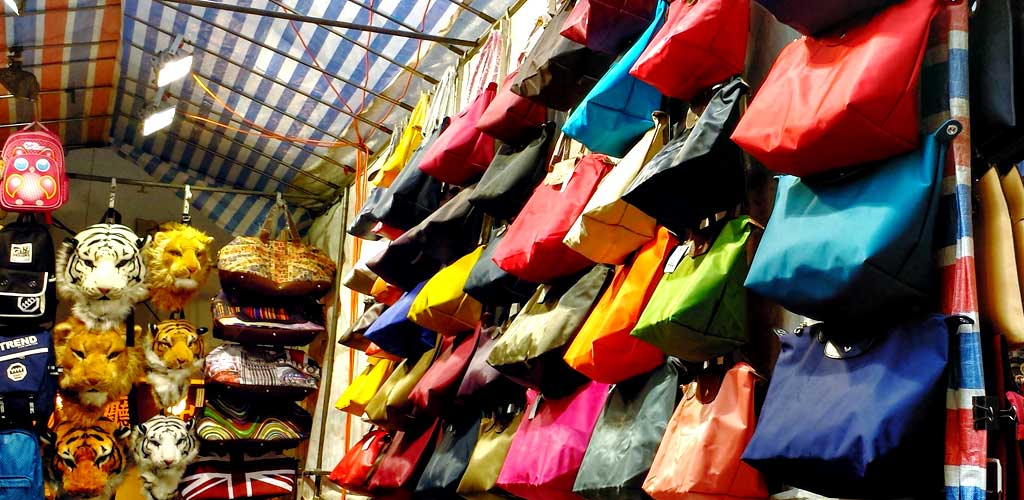
Buy the suitcase last. Luggage is sold at the market, and a spare bag bought on the spot is a common answer to a haul that has outgrown the case you arrived with — a hint rather than a recommendation, since quality varies and you are the best judge of whether it will survive a flight.
A fake "branded" bag is a border risk, not a bargain
One warning belongs here rather than in the shopping pages. Buying a counterfeit item is a market question; carrying one across a border is a different thing entirely. Under Hong Kong's Trade Descriptions Ordinance it is an offence to import or export goods to which a forged trademark is applied — which is exactly what a suitcase of "designer" copies amounts to if you are stopped on the way out. Whether your own country will also seize the goods on arrival is a matter for its customs authority. If the bags in your haul carry a brand name at a fraction of the brand's price, treat that as a border risk and not a saving; our price guide explains how to tell a genuine market item from a copy before you buy.
Questions people ask
Can I get the tax back at the airport?
No. Hong Kong has no VAT or GST and runs no tourist refund scheme, so there is no refund counter, no form and no minimum spend to qualify. If a shop or a website promises a Hong Kong tax refund, it is not describing a scheme that exists.
How much can I bring home?
That is your own country's rule, not Hong Kong's. Hong Kong does not cap the souvenirs you buy or tax them on the way out; the allowance you have to stay under is set by the customs authority of the place you are flying into. Look it up before you fly so the value of your market haul is not a surprise at the other end.
Do I need to declare cash?
Only if the currency and bearer instruments you are carrying total more than HK$120,000, in which case you must declare through the Red Channel on arrival, and may be asked to disclose them on departure. Below that threshold there is nothing to declare.
Can the stall ship it home for me?
Some can, or will point you to a nearby courier. Ask and agree the arrangement at the stall before you pay, keep the shipping receipt, and remember the goods are subject to your own country's import rules either way. For anything bulky, price the shipment against the cost of an extra checked bag.
Where these figures come from
The free-port position, the four dutiable categories and the arrival allowances are from the Hong Kong Customs and Excise Department's page on duty-free concessions. The HK$120,000 declaration threshold, the Red Channel procedure and the penalties are from Customs' page on currency and bearer negotiable instruments. The counterfeit-goods offence is set out in the Trade Descriptions Ordinance, Cap. 362. That Hong Kong levies no general sales tax is the Government's own position, set out in the Financial Services and the Treasury Bureau's background paper "A Goods and Services Tax for Hong Kong". Rules and thresholds can change; check the Customs pages before you travel.